At 54, I Was Terrified I'd Lose My Independence To My Failing Eyes, And Never In A Million Years Would I Have Guessed The Real Cause
One woman's account of the discovery that changed how she sees, literally.
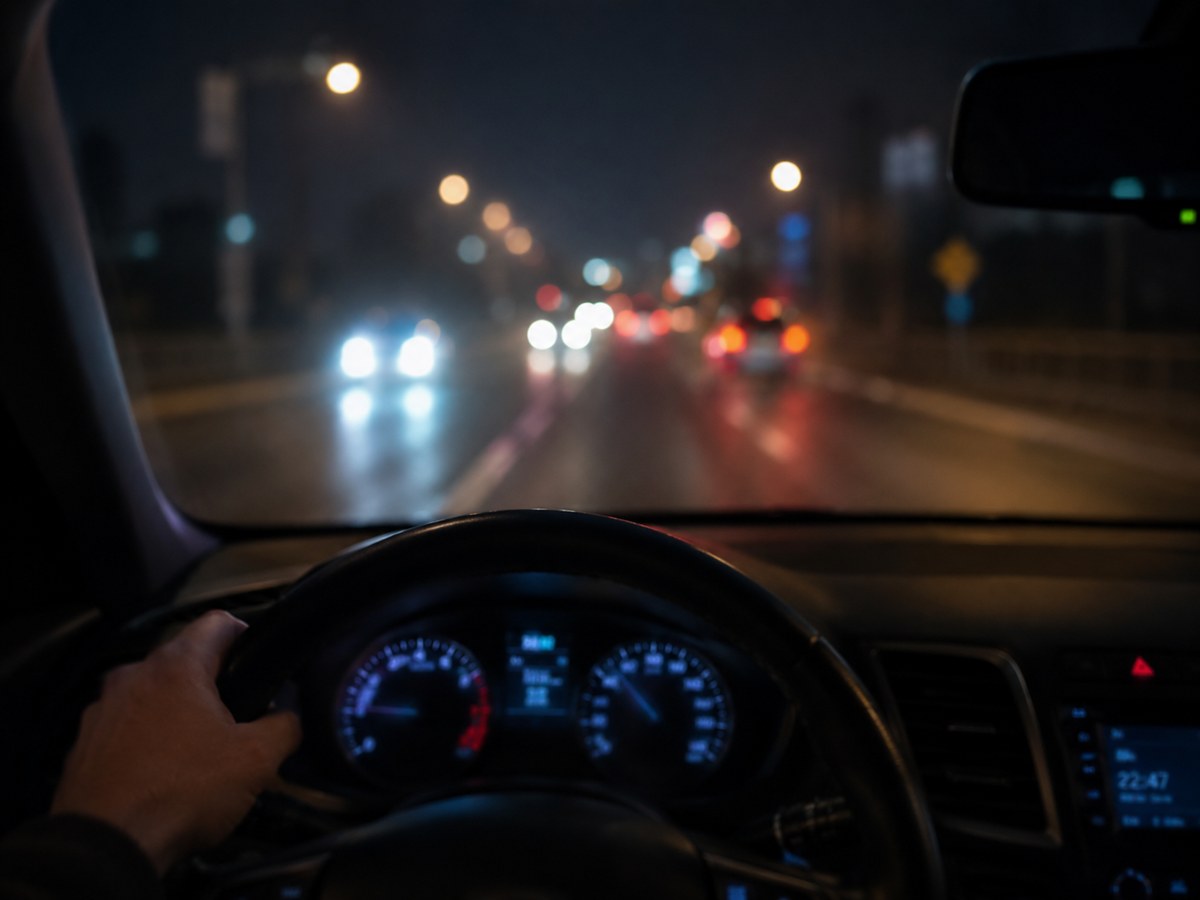
I'll be honest with you: I was scared. Not the kind of scared you shake off by the afternoon. The kind that keeps you staring at the ceiling at 3 a.m.
It started with the night driving. Headlights would smear across the windshield like someone had wiped Vaseline over my eyes. I began making excuses to avoid driving after dark. Then I couldn't read my own phone without stretching my arm all the way out, and even then, the words swam.
The floaters were the worst part. Some mornings it looked like an aquarium in front of my face. Little things just drifting around, no matter how much I blinked.
But the blur and the floaters weren't what truly frightened me.
What frightened me was the thought of one day sitting in the passenger seat, asking one of my kids to drive me to the grocery store. Of handing over the independence I'd spent my whole life building. My mother lost her sight late in her life, and I watched what it did to her. I was terrified I was next.
So I did everything you're supposed to do
New glasses, twice in eighteen months, $400 each time. Prescription eye drops that burned and did nothing. The expensive lutein gummies from the pharmacy, the ones with the little eye on the bottle, $35 a month. I ate more spinach. I cut my screen time. I even bought one of those amber "blue light" glasses everyone swears by.
I must have spent close to two thousand dollars in a single year trying to save my own eyes. And still, it kept getting worse.
That's the part nobody prepares you for. You do everything right, you spend money you don't really have, and your eyes keep slipping away like none of it mattered. I saw three different eye doctors. Every one of them looked into my eyes, told me it was "just age," and sent me home with the same pamphlet.
Not one of them mentioned the thing that finally made the difference.
Because it had nothing to do with my eyes.
The question my eye doctor never thought to ask
It was actually my daughter, who works in healthcare, who set me down a different path. She asked me a question none of my doctors had:
"Mom, how's your gut been?"
I almost laughed. What on earth did my stomach have to do with my eyes?
But she'd been reading about something researchers now call the gut-eye axis. And the more I looked into it, the more the whole picture started to make a terrible kind of sense.
Here's what I wish someone had explained to me years ago. I'll tell it the way my daughter told me, because I needed it in plain English, not medical jargon.
As we age, the lining of our gut can start to break down. Doctors call it "leaky gut." When that happens, toxic particles, they're called LPS, slip through the gut wall and into your bloodstream. And the bloodstream carries them everywhere, including the tiny blood vessels that feed the part of your eye you use to read, recognize faces, drive.
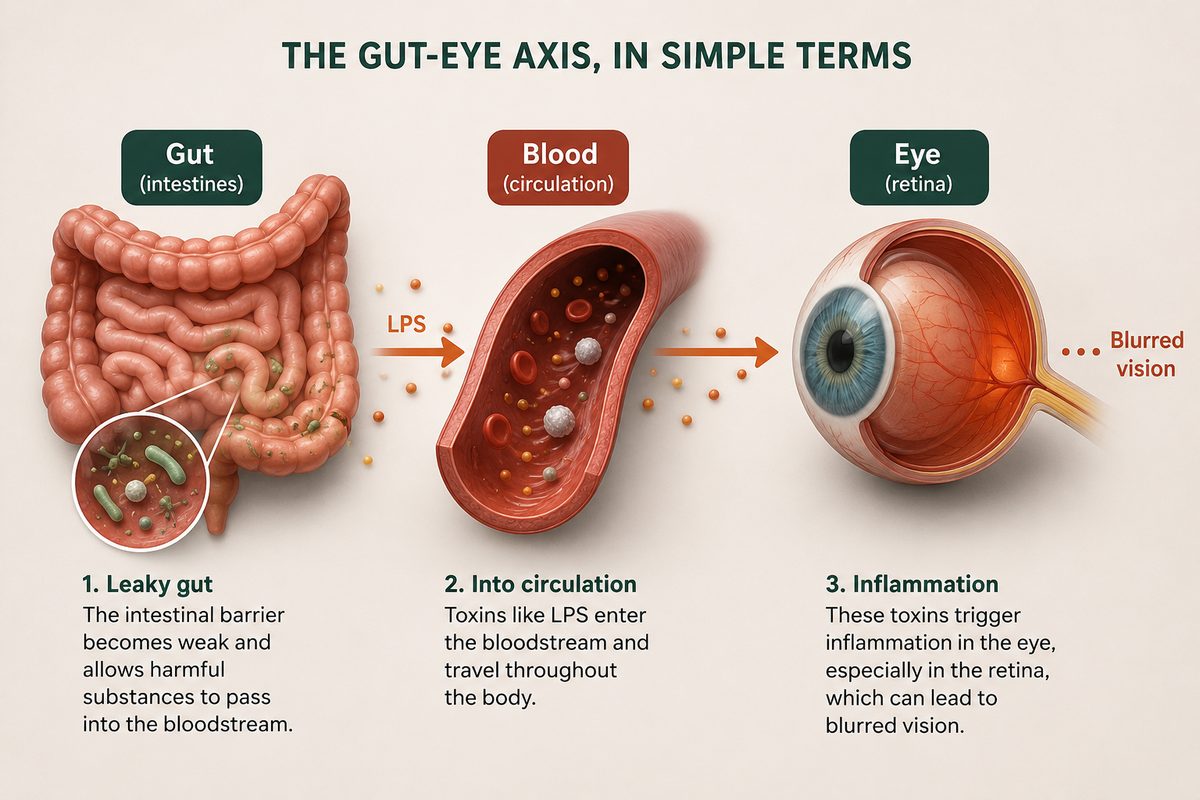
Read that again, because it's the part that stopped me cold: the inflammation attacking my vision may not have been starting in my eyes at all. It was being delivered there, from my gut.
Suddenly it all fit. No wonder the eye drops didn't work. No wonder the fancy glasses and the gummies didn't move the needle. I'd been treating the smoke for years, while the fire was burning somewhere else entirely.
"But is this actually real, or just another internet theory?"
That was my exact reaction, and if you're skeptical right now, good. You should be. I'd been burned enough times to stop believing easy answers.
So I did what my doctors apparently hadn't: I went looking for who was actually saying this.
It turns out the gut-eye connection isn't a fringe idea from a wellness blog. Ophthalmology and eye-care clinics have quietly started writing about it.
Clinics like Mount Airy Medical Eye Center and Evolutionary Eye Care have written about this for their own patients. A study from last year spelled the whole thing out, how the gut barrier breaks down, how LPS gets into circulation, how it ends up inflaming the retina. This isn't some fringe blog theory. Eye doctors are saying it.
I'm not asking you to take my word for it. I'm asking you to notice that eye doctors themselves are starting to point at the gut. That was enough to make me stop dismissing it.
The logic was simple once I saw it: if inflammation from the gut is part of what's stealing people's vision, then protecting the gut and calming that specific inflammation should matter just as much as anything you drop into your eyes.
And that's when it hit me: not a single eye supplement I'd ever tried did anything about the gut. Every bottle on the shelf went after the eye. Not one of them touched the place where the problem actually started.
The one thing built the way I needed it
For about two weeks after I understood this, I felt worse, not better. Because now I knew exactly what was happening inside me, and I couldn't find a single thing designed to do anything about it. I searched. I read labels. Everything was "eye support," lutein, zinc, bilberry, the same ingredients I'd already wasted money on. Nothing went after the gut.
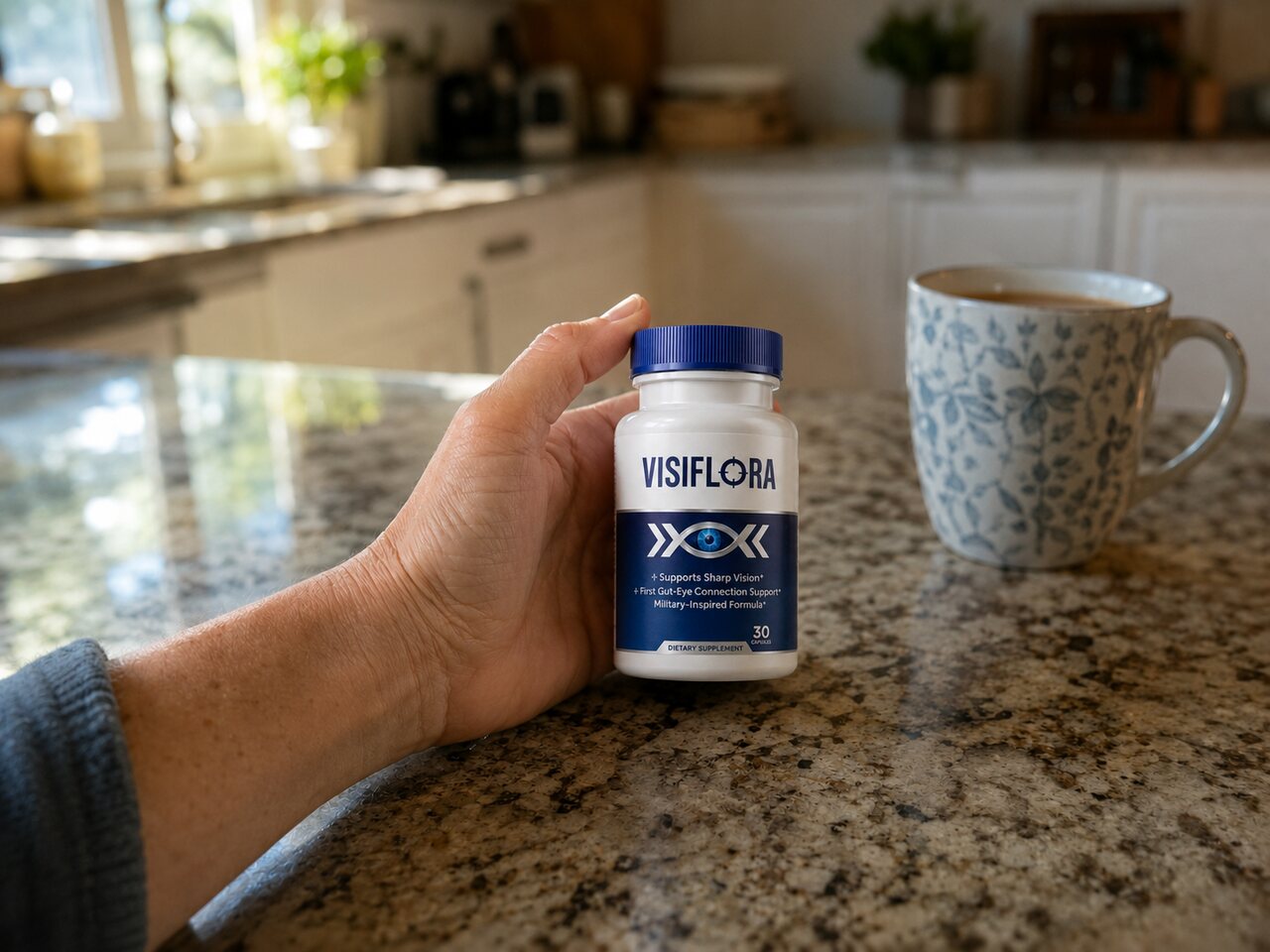
I'll be straight with you about my first reaction when I finally did find something, because it matters. A supplement called VisiFlora. My gut response was to roll my eyes. "Great," I thought. "Another bottle. Another promise." I had a drawer full of those already.
What made me stop was the label. It was the first one I had ever seen that didn't just throw lutein at my eyes and call it a day. Yes, it had the eye-support nutrients, the lutein and zeaxanthin my macula needed, the bilberry for night vision, the AREDS2 antioxidants the research actually backs. Every other bottle in my drawer had some version of that.
But this one did the part every single one of them had missed. It included what they call a "Gut Armor" complex, ingredients meant to shore up the gut lining and help neutralize those LPS particles before they ever reached my eyes. It was going after both ends of the gut-eye axis at the same time. The fire and the smoke, not just the smoke.
For the first time in three years, I wasn't just wiping the windshield over and over. I was finally doing something about whatever kept fogging it up.
If you want to see that Gut Armor complex broken down before the rest of my story, here is what is in it.
The morning everything changed
I want to be careful here, because the wild promises are exactly what kept me stuck and broke for so long. So I won't tell you it happened overnight. It didn't.
For the first couple of weeks, honestly, I felt nothing, and the old cynic in me started whispering "I told you so." Then, somewhere in the third week, something small happened that I'll never forget.
I was reading a text from my daughter, and I realized my arm wasn't stretched out. The phone was just where a phone is supposed to be, and the words were sitting still on the screen. No swimming. I read it twice, not because I couldn't see it, but because I could.
A few nights later I drove to pick up my grandson after dark, something I had quietly stopped doing months earlier. The headlights coming toward me were headlights again. Not smeared halos. Just lights.
I sat in that parked car for a minute before I went in, and I cried. Not because my vision was suddenly perfect, it isn't, I'm not going to lie to you. I cried because for the first time in three years, the clock wasn't running out. That 3 a.m. fear of becoming a burden to my kids finally loosened its grip on my chest.
I sleep through the night now. The ceiling at 3 a.m. doesn't scare me anymore.
If your eyes keep slipping away no matter what you try, I'm not going to tell you what to do. I'll just tell you the one thing that almost cost me my sight: I spent three years treating my eyes, when the problem was never in my eyes to begin with.
If you want to see how the gut-eye connection works, and what I found when I finally looked in the right place, here is where I started.
Learn how the gut-eye connection affects your vision after 40.
See how the gut-eye connection worksYou can read more about the science and the formula on this page.